One thing I feel strongly about in yoga is this: we should know why we are doing a pose.
Not in a philosophical sense for now, but in a physical, practical sense.
A yoga pose is not just a random shape. It is not something we do only because it looks nice, or because it is there in a textbook, or because someone on Instagram is doing it. A pose is supposed to create a certain effect in the body. If we understand that effect, we practise with much more intelligence. And when we practise with intelligence, we get much more out of the pose.
Let me explain.
Take Extended Triangle Pose, for example.
This pose is not just about touching the floor or reaching the shin or looking elegant. Ideally, it should help stretch the hamstrings, lengthen the side body, and build strength in the legs. But that only happens if the pose is done in the right direction.
If, instead of moving sideways, I simply bend forward and collapse toward the floor, then the purpose of the pose is lost. It may still look like Triangle Pose from the outside, but the body is not receiving the intended benefit in the same way. That is why understanding the purpose matters. When I know what the pose is meant to do, I know what I should be looking for while practising it. I know what kind of sensation is relevant, and I know when I am drifting away from the actual work of the pose.
This becomes even more important when you are teaching.
If I understand what a pose is doing in the body, I do not become dependent on that one pose alone. I can adapt. I can substitute. I can make the practice more accessible without losing its purpose.
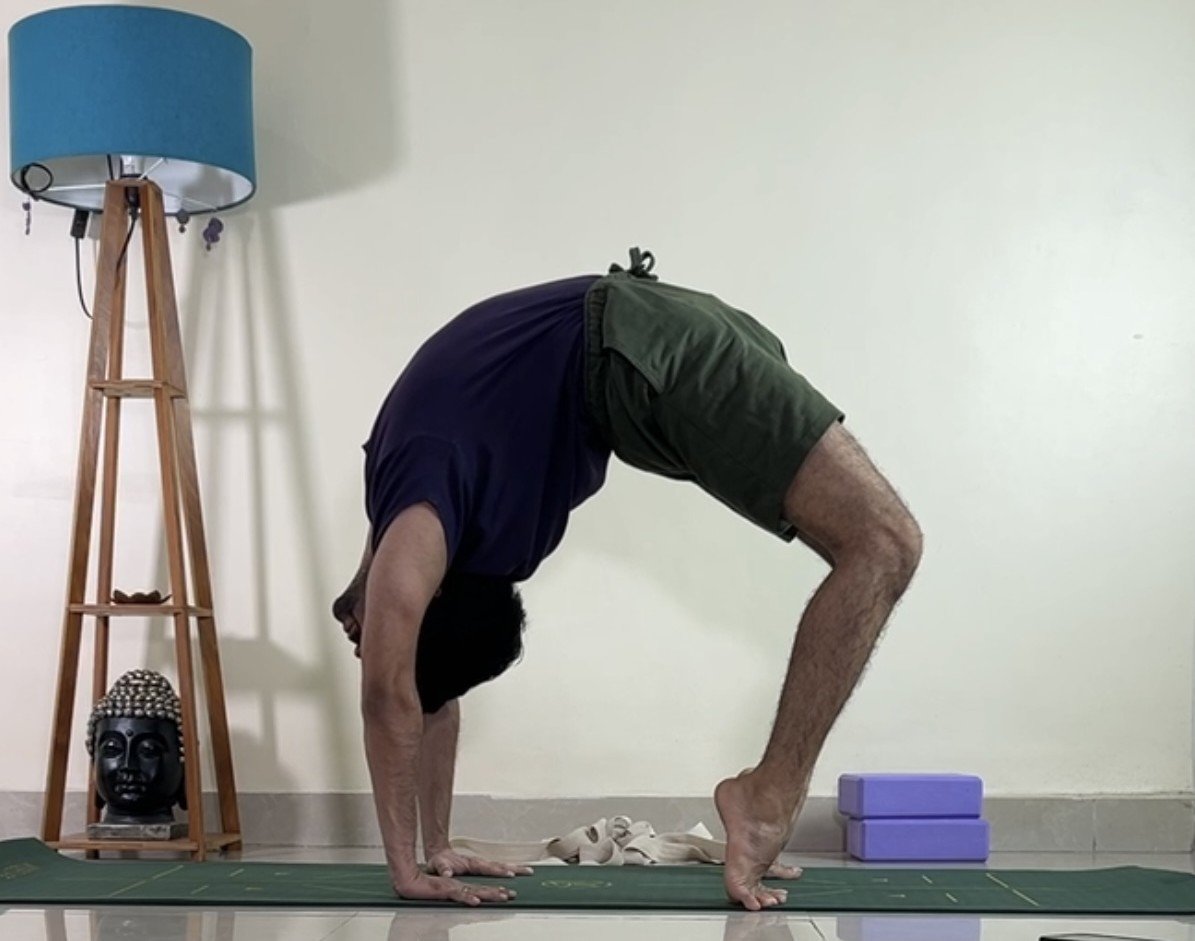
For example, suppose I want a student to open the front of the body and strengthen the back body. But let us also say that this student has an unstable shoulder and raising the arms overhead in a standing backbend is not a good idea right now.
In that case, I do not have to force the original pose just because that was the planned sequence. I can choose another route.
Instead of a standing backbend, I may use poses such as Cobra, Sphinx, or Locust. These prone backbends can still help create a similar action in the body. They can still work on extension of the spine, opening across the chest, and strengthening the back muscles, but in a way that is safer and more suitable for that person.
This is why knowing the purpose of a pose is so useful. It helps both the student and the teacher.
As a student, it helps you stop chasing shapes blindly.
As a teacher, it helps you teach people, not poses.
And that difference matters.
Because no two bodies are the same. Some students are stiff. Some are hypermobile. Some are returning after years. Some are working with injuries. Some are simply tired after long days at a desk. If we only think in terms of textbook poses, yoga becomes rigid. But if we understand the purpose behind the pose, yoga becomes intelligent, adaptable, and much more humane.
To me, that is where real practice begins.
Not when you can do the most advanced shape in the room, but when you start understanding what the shape is trying to do in your body.
That is when the practice stops being mechanical and starts becoming meaningful.